
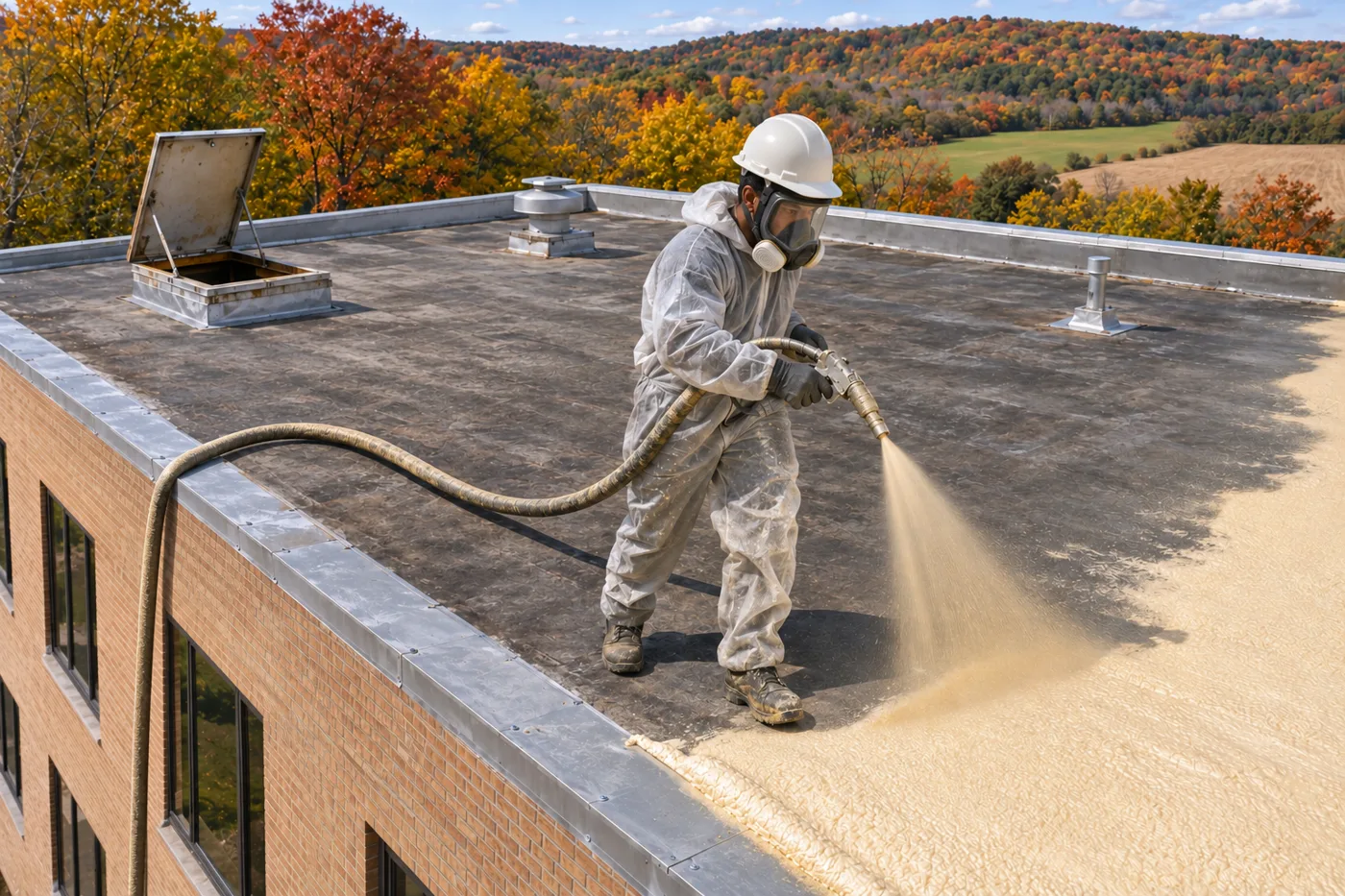
Leaks Around Crowded Penetrations
- You See
- Many pipes, vents, and curbs, each with its own patched flashing.
- What It Means
- Foam seals around every penetration in one continuous layer, which removes the separate flashings that keep failing.
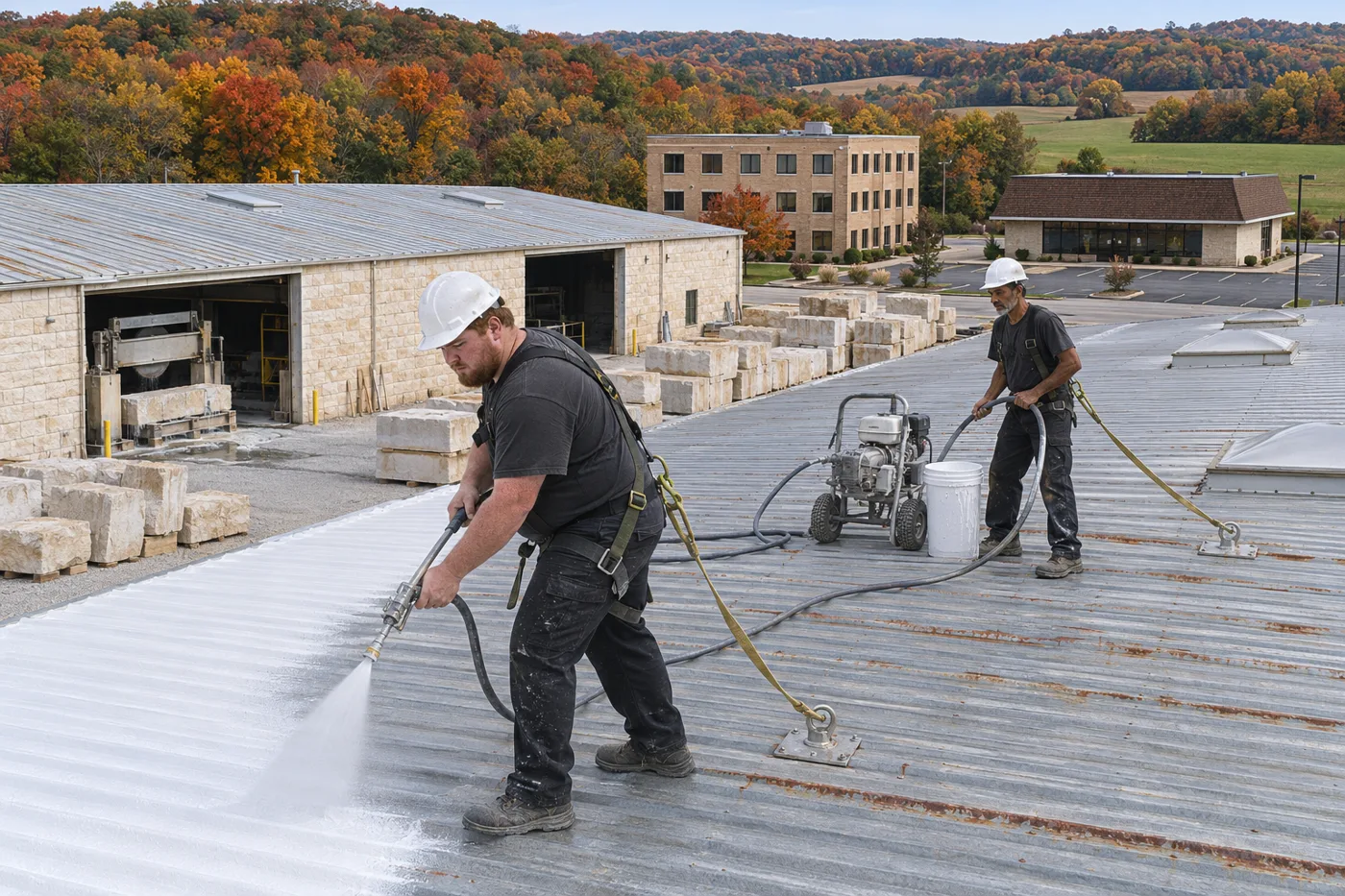
As a Bloomington spray foam roofing contractor, we spray foam over metal, built-up, and single-ply roofs, then topcoat it, adding insulation without a tear-off.
Bloomington spray foam roofing fits roofs that are dry, solid, and short on insulation. These checks decide whether foam belongs on yours.
| Check | Good Fit For Foam | Fix Or Choose Another System |
|---|---|---|
| Substrate | Dry metal, built-up, or single-ply | Wet insulation under the surface |
| Insulation Need | Building runs hot or cold | Roof already well insulated |
| Penetrations | Many pipes, curbs, and vents | Few penetrations, simple shape |
| Site Exposure | Room to control overspray | Cars and intakes right beside the roof |
| Upkeep Plan | Topcoat renewed on schedule | No plan to inspect or recoat |
Foam is the right call for these four problems on Bloomington roofs.
Foam is one system among five. Here is where the others fit on Bloomington roofs.
Rust treatment, sealed laps, and coating for steel that needs no added insulation.
Silicone over clean low-slope roofs, and as a topcoat over finished foam.
Acrylic for sloped roofs that drain well, and as an option for foam topcoats.
Spray foam with a topcoat for roofs that need insulation and fewer seams.
Shingle-rated coating for asphalt sections that are still in good shape.
Foam goes over the existing roof and adds insulation at the same time. Here is how it compares with tearing off.
| What Changes | Coating The Roof | Replacing The Roof |
|---|---|---|
| Tear-Off | Old roof stays as the base | Old roof and insulation removed |
| Insulation | Added in the same step | New board installed separately |
| Penetrations | Sealed in one continuous layer | Each one reflashed |
| Debris | Little waste leaves the roof | Full tear-off hauled away |
| Upkeep | Topcoat renewed on schedule | Membrane seams checked over time |
Roofs crowded with penetrations keep leaking at the flashings. Call us to talk through whether foam fits your roof.
Call UsFoam needs dry weather and careful site control, so each step is planned around the forecast.
We take core samples and moisture readings, check the deck, and note every penetration, intake, and parked-car area near the roof.
Wet insulation is removed and replaced, loose material is fastened, and the surface is cleaned so the foam sticks to a dry base.
Air intakes are shut down or covered, and wind speed is checked so overspray stays on the roof.
Foam goes on in passes to the planned depth, built thicker at low spots to send water toward drains.
A silicone or acrylic topcoat goes on within the maker's time window, since sunlight breaks down bare foam.

Roofs with enough insulation often do fine with coating alone.
Metal restoration for steel roofs where the insulation is already adequate.
Silicone coating for low-slope roofs, and a common topcoat on foam.
Acrylic for sloped panels and an option for topcoating foam.
Coating for asphalt shingle areas on the same property.
Upkeep, weak points, and fit come up most when owners weigh foam.
Coated foam keeps working as long as the protective topcoat is renewed on schedule, because that coating is what shields the foam from sunlight. Hail punctures and foot-traffic damage get repaired quickly so water never reaches the foam.
Recoating is due once the topcoat has worn thin, which we confirm by measuring its thickness and looking for exposed foam. The roof is cleaned, damaged spots are patched, and a new coat goes over the foam. Recoating on time avoids removing foam later.
One insulating layer seals around penetrations and can be built up to improve drainage. On the other side, foam needs dry, mild weather to apply, overspray must be controlled near intakes and parked cars, and the topcoat must be maintained. Plants with many penetrations gain the most.
Installation depends on the weather, applicators need training to reach even thickness, and the roof relies on regular recoating. Birds and sharp objects can damage the surface, and once water gets under the topcoat, small leaks are harder to trace. Good installation and inspections manage all of these.
Metal panels take foam once rust is treated, loose screws are tightened, and the panels are clean and dry. The foam fills the ribs and covers screw rows, so the old roof becomes the base for one continuous layer. Wet insulation below is removed first.
Insulation goes across the whole roof without gaps at fasteners or seams, which helps keep conditioned air inside. How much it changes your bills turns on what is there now and how the building runs, so we leave out promised numbers.
Foam depth is set on the roof plan for each area, thicker over low spots that need slope toward drains and to the planned insulation value elsewhere. We probe the foam as it goes on and record the depth, then check the topcoat thickness after it cures.
Tell us how many pipes and curbs your roof has and how the building runs. We check whether foam fits and price it.