Age
Screw Rows Backing Out
- You See
- Raised screw heads and washers split around the shank.
- What It Means
- Panels expand and shrink every day, which works screws loose. We pull them, fill wallowed holes with larger screws, and seal each head.

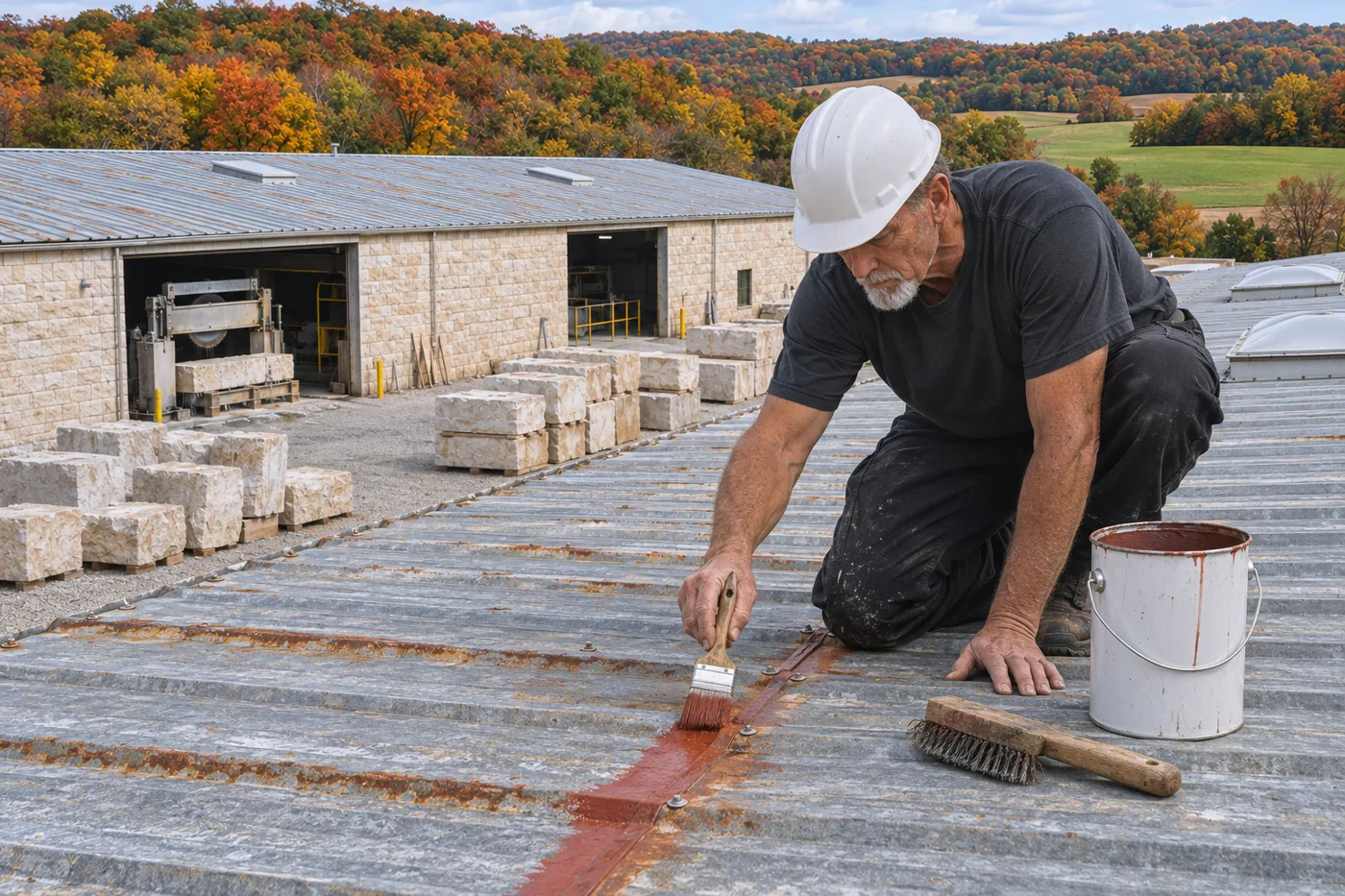
As a Bloomington commercial metal roof coating contractor, we treat rust, reset screws, seal laps, and coat the steel roofs on plants, shops, and warehouses.
Bloomington commercial metal roof coating fits exposed-fastener and standing-seam steel that still carries weight. These checks separate a coating job from a repair or a replacement.
| Check | Good Fit For Coating | Fix Or Replace First |
|---|---|---|
| Panel Steel | Surface rust on solid ribs | Rust holes or flaking through the panel |
| Screws | Tight screws with worn washers | Stripped holes or rotted purlins |
| End Laps | Dirt and light scale in the lap | Laps lifted or bent open |
| Insulation | Dry readings across the roof | Wet readings over large areas |
| Roof Slope | Sheds water within a day | Bays that sag and hold water |
| Old Coatings | Factory paint with light chalking | Earlier coating peeling off in sheets |
Most metal roofs we coat show at least three of these. Each one gets fixed before the coating goes on.
Each system has its own place on a metal property. Here is where each one fits around Bloomington.
The full system for exposed-fastener and standing-seam steel, with rust primer, sealed laps, and a field coat sized to the roof.
Flat or nearly flat sections, such as office additions and low-slope wings, where water stays for a day after rain.
Steeper metal with fast drainage, where a water-based coating in two colors keeps the cost per square foot down.
Old metal roofs that need insulation and a smoother surface, with foam sprayed over the ribs and coated on top.
Shingle sections on the same property, such as an office front, coated with a shingle-rated product.
Coating keeps your existing steel in service and stops the leaks at the joints. Here is how it compares with new panels.
| What Changes | Coating The Roof | Replacing The Roof |
|---|---|---|
| Existing Panels | Stay in place and keep working | Removed down to the purlins |
| Price Range | About $2.50 to $4 per sq ft | About $5 to $8 per sq ft |
| Downtime Below | Plant floor keeps running | Bays opened to weather in stages |
| Screw Holes | Old holes sealed under the coating | New holes in new panels |
| Rust Control | Primer stops rust at laps and edges | Fresh paint on new steel |
| Future Work | Clean and recoat the surface | Coat new panels when paint wears |
Rust at end laps spreads fastest. Book an inspection and we will mark every lap and screw row that needs work before coating.
Get A Free EstimateEach step leaves the roof drier and tighter than the one before. Here is the order we follow.
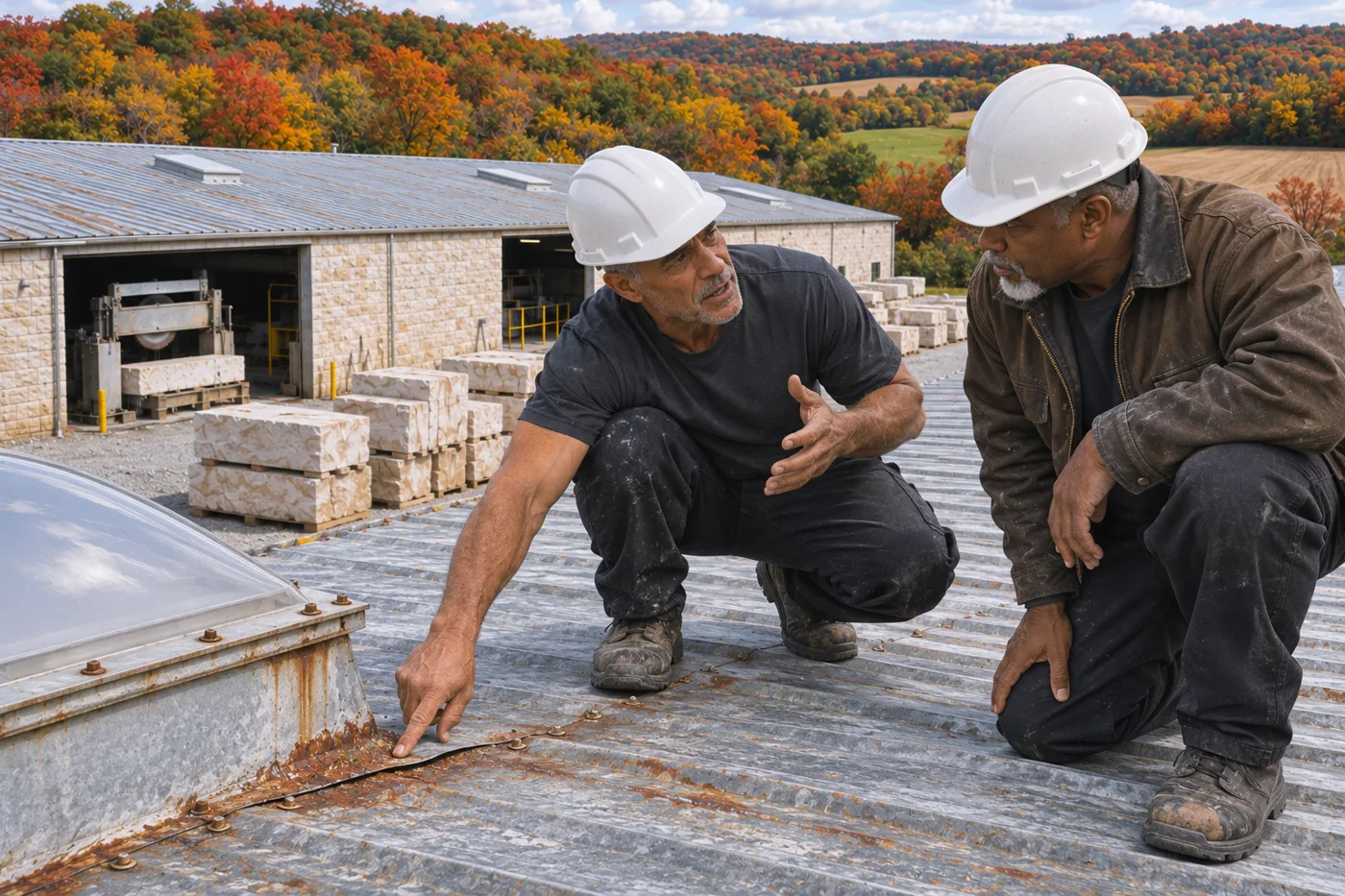
We check every panel run for rust holes, test screws, open a few laps, and read the insulation with a moisture meter. The findings are marked on a roof plan you keep.
Loose scale comes off with wire brushes and grinders. Exposed steel gets a rust-inhibiting primer before the crew quits for the day, so fresh rust has no time to form.
Stripped and backed-out screws are replaced with oversized ones and new washers. Each head then gets a dab of sealant or a coating cap.
Side laps, end laps, and trim joints get reinforcing fabric bedded in base coat. This is where most leaks start on metal roofs.
Base and finish coats go on across ribs and flats to the specified thickness, checked with a wet-film gauge as we spray.
Parts of a metal property sometimes call for a different system.
Low-slope wings that pond after rain take silicone over the same rust and seam prep.
Steep, fast-draining panels can use a water-based acrylic in two colored coats.
Roofs that need insulation get spray foam over the metal and a coating on top.
Shingle sections on an office front get their own shingle-rated coating.
Answers to the rust, restoration, and product questions we hear on Bloomington metal roofs.
Cleaning comes first: pressure washing removes dirt and chalk, and hand or power tools take off loose rust. Rusted and bare steel gets a rust-inhibiting primer matched to the coating. Any panel with holes is replaced. Treated this way, the coating stays attached and rust stops creeping underneath it.
Restoration covers cleaning, rust treatment, new fasteners where old ones failed, reinforced mastic at seams and laps, flashing repairs at curbs and edges, and a complete coating system. The old roof stays where it is, so there is no tear-off debris and the building stays open while the crew works.
Slope and drainage decide it. Acrylic suits sloped panels that shed water fast. Silicone suits low-slope areas that hold water and stands up to UV. A urethane base coat adds toughness where hail or foot traffic is heavy. We pick the system after the inspection, based on your roof.
Film thickness and surface preparation matter more than the brand name. Silicone and urethane systems applied at higher dry film thickness hold up longest, and many can be recoated later. Skipped primer or a rushed wash shortens any product, so we measure thickness as the coating goes on.
Coating runs about $2.50 to $4.00 per square foot, with the final price set after an inspection. Roof size, the amount of rust treatment, how many seams and screws need sealing, panels to replace, lift access, and the coating system all move the number within that range.
Work stays on top of the roof, so the floor below keeps running. We stage lifts and materials away from dock doors, time spraying around intake fans, and cover rooftop units before any spray work. Grinding at the laps is planned around your shift times.
Send us the roof size and a photo of the worst lap, or call. We inspect the roof and price the full system.